
cloud
Multi-Cloud Strategy: Benefits, Challenges & Best Practices for Enterprises
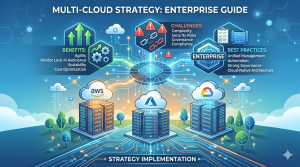
Enterprises rarely fail because they chose the wrong cloud; they struggle because they rely too heavily on a single provider, which limits flexibility, increases risk, and reduces control over performance and costs. A well-defined multi-cloud strategy addresses these gaps by distributing workloads across providers like Amazon Web Services, Microsoft Azure, and Google Cloud Platform, enabling organizations to build systems that are more resilient, adaptable, and less dependent on any one ecosystem.
What is a Multi-Cloud Strategy?
A multi-cloud strategy is not just about using multiple cloud providers simultaneously; it is about making deliberate decisions on where and how workloads should run to maximize performance, reliability, and flexibility. Enterprises adopt this approach to align specific workloads with the strengths of different platforms while reducing dependency risks.
Workload distribution across cloud providers
Enterprises distribute workloads based on capabilities rather than convenience. For example, a fintech company may run its transaction systems on AWS for scalability, use Azure for identity and enterprise integrations, and rely on GCP for fraud detection using machine learning. This targeted distribution ensures each system operates in the most suitable environment.
Strategic, not accidental, multi-cloud adoption
Many organizations unintentionally become multi-cloud due to acquisitions or team-level decisions. However, without a defined strategy, this leads to fragmented systems. A structured approach ensures consistency, governance, and better long-term scalability.
Key Benefits of a Multi-Cloud Strategy
The real value of a multi-cloud strategy lies in its ability to give enterprises control over performance, risk, and cost, but these benefits only materialize when the architecture is intentionally designed and actively managed.
Improved flexibility and reduced vendor lock-in
Relying on a single provider creates long-term dependency, which can limit innovation and negotiation power. Multi-cloud strategies allow enterprises to shift workloads when needed and avoid being constrained by a single ecosystem.
A practical example can be seen in global SaaS companies that move non-critical workloads between providers to optimize costs during pricing changes, ensuring they are not locked into a single vendor.
Enhanced reliability and uptime
Cloud outages, even from major providers, can disrupt entire systems when everything is hosted in one environment. A multi-cloud strategy reduces this risk by distributing services across providers.
For instance, during major AWS outages, companies with backup workloads on Azure or GCP were able to maintain partial functionality, ensuring that critical services remained available to users.
Better performance optimization
Different providers excel in different areas, and multi-cloud allows enterprises to take advantage of these strengths. This leads to improved application performance and better user experience.
Streaming platforms, for example, often use multiple clouds to deliver content efficiently across regions, ensuring low latency and consistent performance.
Cost optimization opportunities
Multi-cloud enables cost flexibility, but only when usage is actively monitored. Enterprises can allocate workloads to cost-efficient environments and avoid overpaying for services that may be cheaper elsewhere.
Challenges of Implementing a Multi-Cloud Strategy
While the benefits are compelling, the complexity of managing multiple cloud environments introduces operational challenges that can quickly offset the advantages if not handled correctly.
Increased operational complexity
Each cloud provider has its own tools, configurations, and interfaces, which makes managing them together difficult. Teams must navigate multiple systems, increasing the chances of errors and slowing down operations.
A common scenario involves engineering teams switching between dashboards during an incident, which delays decision-making and increases downtime.
Lack of unified visibility
Without centralized monitoring, teams struggle to get a complete view of system performance. Alerts and metrics are often scattered across platforms, making it harder to identify root causes quickly.
This becomes particularly problematic during high-impact outages, where every minute of delay affects user trust and revenue.
Monitoring and incident management gaps
In multi-cloud environments, incidents often span multiple systems and providers. Without a unified approach, teams may miss early signals or fail to coordinate effectively.
For example, an issue originating in AWS may trigger failures in services running on GCP, but without centralized visibility, teams may treat them as separate problems. Platforms like itechops help address this by consolidating alerts, enabling cross-cloud incident tracking, and ensuring that communication remains consistent during critical events.
Security and governance challenges
Different providers follow different security models, which can lead to inconsistencies if not standardized. Without proper governance, organizations risk misconfigurations and compliance issues.
Best Practices for a Successful Multi-Cloud Strategy
To make a multi-cloud strategy effective, enterprises need to focus on consistency, visibility, and coordination across all environments rather than treating each cloud as a separate entity.
Define workload-specific strategies
Not all applications need to be distributed across multiple clouds. Enterprises should evaluate which workloads benefit from flexibility, redundancy, or specialized capabilities and design their strategy accordingly.
Standardize infrastructure and deployments
Using technologies like Kubernetes and Infrastructure as Code (IaC) ensures consistency across environments. This reduces complexity and simplifies scaling and migration.
Implement centralized monitoring and observability
A unified monitoring system is critical for managing multi-cloud environments effectively. By consolidating data and alerts, teams can respond faster and make informed decisions.
In practice, organizations using platforms like itechops can track incidents across AWS, Azure, and GCP in a single interface, reducing confusion and improving response times during outages.
Establish clear incident response workflows
Well-defined processes for incident management ensure that teams can act quickly and efficiently. This includes assigning ownership, defining escalation paths, and maintaining clear communication protocols.
Strengthen governance and security policies
Standardizing security and compliance measures across all cloud environments minimizes risks and ensures consistency in operations.
Continuously monitor and optimize costs
Regular cost analysis helps identify inefficiencies and eliminate redundant resources. Without this, multi-cloud environments can become expensive and difficult to manage.
Common Mistakes to Avoid in Multi-Cloud Strategy
Most failures don’t come from bad intentions, but from incomplete thinking.
Common patterns include:
- Adopting multi-cloud without a clear reason
- Assuming providers will “just work together”
- Ignoring monitoring and incident coordination
- Underestimating operational overhead
The result is a system that looks advanced on paper but struggles under pressure.
Conclusion
A multi-cloud strategy can significantly improve flexibility, resilience, and performance, but its success depends on execution rather than intent. Enterprises that focus on unified monitoring, standardized processes, and strong incident management practices are better equipped to handle the complexity of distributed systems.
In this context, solutions like itechops play a key role in bringing structure to multi-cloud operations by enabling centralized visibility and coordinated incident management, ensuring that enterprises can scale without losing control.
FAQs
How is multi-cloud different from hybrid cloud?
A multi-cloud strategy uses multiple public cloud providers, whereas a hybrid cloud combines public cloud with private or on-premise infrastructure. Multi-cloud focuses on provider diversification, while hybrid cloud focuses on integrating different infrastructure environments within a single architecture.
When should a company consider adopting a multi-cloud strategy?
A company should consider a multi-cloud strategy when it faces scaling challenges, needs higher resilience, operates across multiple regions, or requires specialized services from different providers. It is also relevant when business continuity and flexibility become critical to operations.
Does a multi-cloud strategy increase operational costs?
It can increase costs if not managed properly due to duplicated resources and inefficient usage. However, with proper cost monitoring and workload optimization, enterprises can balance spending and avoid over-reliance on expensive services from a single provider.
What skills are required to manage a multi-cloud environment?
Managing a multi-cloud environment requires expertise in cloud architecture, DevOps practices, automation tools, and cross-platform monitoring. Teams also need strong problem-solving skills to handle distributed systems and ensure smooth coordination across multiple platforms.
How does compliance work in a multi-cloud setup?
Compliance in a multi-cloud setup requires aligning policies across all providers while adhering to regional and industry-specific regulations. Organizations must implement centralized governance frameworks to ensure consistent security, auditing, and regulatory compliance across environments.
Can small businesses benefit from a multi-cloud strategy?
Multi-cloud is not always necessary for small businesses, especially in the early stages. However, as operations grow and dependency risks increase, adopting a selective multi-cloud approach can help improve flexibility and reduce the impact of service disruptions.